Maria das Mercês Luiz de Queiroz
Miriam bat Yosef HaLevi (מרים בת יוסף הלוי) · Brazilian Jewish educator, born in Brasília de Minas (fl. mid-20th century)
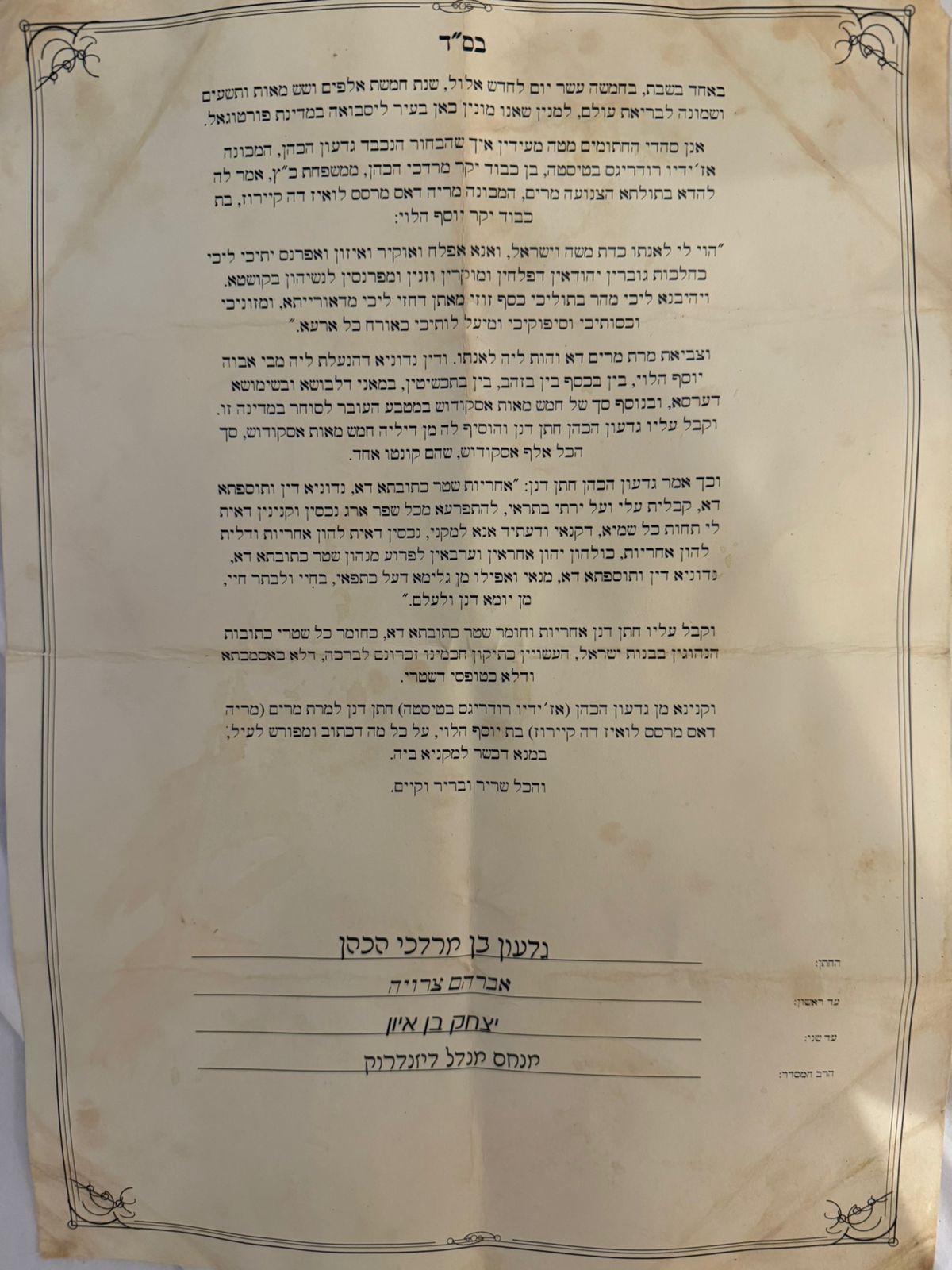
Maria das Mercês Luiz de Queiroz (twentieth century), known by the Jewish name Miriam bat Yosef HaLevi (מרים בת יוסף הלוי), was a Brazilian Jewish educator, born in Brasília de Minas, in northern Minas Gerais, the daughter of José Luiz de Queiroz and Emiliana Maria das Mercês. From early on she took part in the family's regular crossings between Brazil and Portugal, voyages on which she and her father escorted Jewish families emigrating to the mineiro interior. It was during one of these stays that she married Egídio Rodrigues Batista — Jewish name Gideon HaKohen (גדעון הכהן), son of Mordechai HaKohen, of the Katz family — in Lisbon on the 15th of Elul 5698 (September 1938), the same Hebrew date as her parents' wedding twenty-eight years earlier; the ceremony was recorded in a ketubah drawn up in that city, reproduced below. She returned to Brazil the following year.
Back in the mineiro interior, she joined the work her father conducted among the Jewish families of the region and devoted herself to the education of their children. She founded cheders — traditional elementary classes of Jewish instruction — in her own home, and traveled from house to house teaching children the prayers and the use of the siddur, sustaining religious instruction among families scattered along the peddling routes. She is remembered as one of the first morot — women teachers of Judaism — active in Brazil.
Her work belongs to a context in which formal Jewish institutions had not yet reached the interior of Minas Gerais. The communities forming around itinerant commerce had no synagogues, schools or resident rabbis, and the transmission of religious knowledge depended on the home: the cheder kept in a family's front room, and the teacher who came to the door. In dispersed communities of this kind, that task fell largely to women, and the figure of the morá — teaching children their first prayers and their first Hebrew letters — was often the sole thread connecting a new generation born in Brazil to the practice of its parents. Her teaching thus complemented the economic absorption offered by the merchant network with what it could not provide by itself: religious and cultural continuity.
Documents